
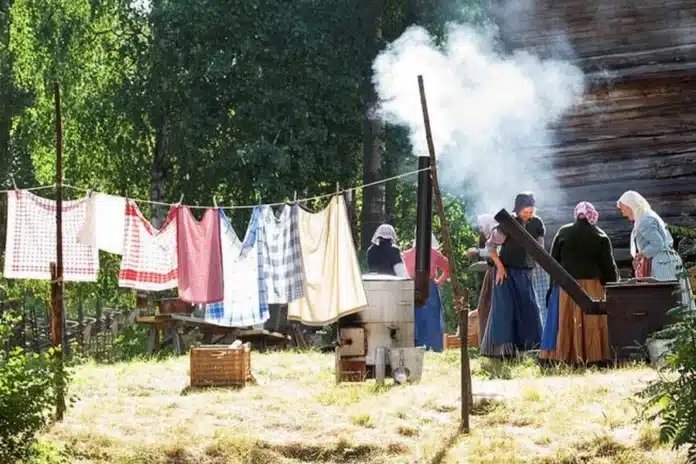
Complaining about taking out the trash? Frontier children were chopping firewood, hunting their own dinner, and pouring hot wax into candle molds — often before they hit double digits.
Here’s a stat that says a lot about how childhood has changed. When U.S. parents were surveyed in 2014, 82% said they’d done household chores growing up — but only 28% expected the same from their own kids. And the gap has only widened since. By 2025, a survey of children in Ireland suggested that roughly four out of five kids do no household chores at all.
Now rewind about 150 years.
On the American frontier of the 1800s, children weren’t just occasionally asked to help — they were essential to whether the household survived the season. There were no faucets, no light switches, no grocery aisles, no mail trucks, and no cleaning products in a spray bottle. Every drop of water, every meal, and every candle had to be produced by hand. And a surprising amount of that labor landed squarely on kids, sometimes as young as four.
These weren’t “tidy your room” chores. These were survival chores. Here are eight of them.
1. Chopping Wood
Wood was the frontier equivalent of electricity, natural gas, and the hardware store rolled into one. It fueled the cooking fire and the stove, and it was the raw material for shelters, fences, furniture, and just about everything else a family needed to build.
With that much timber to fell, split, and haul, kids were handed an axe about as soon as they were tall and strong enough to swing one safely. Wood-chopping wasn’t a rite of passage — it was a daily necessity.
2. Fetching Water
No plumbing meant water didn’t come to you; you went to the water. Frontier families collected rainwater, dug wells, hiked to nearby streams and springs, and even melted snow in winter to keep clean water flowing into the home.
Families lucky enough to settle early and claim land near a creek or river often handed the water run to their children. Armed with pitchers, pans, and anything else that could hold liquid, kids would make the trek to the water’s edge and back while the adults tackled heavier work elsewhere. You can read more about the day-to-day realities of frontier water and homestead life through PBS’s Frontier House resources.
3. Working the Land (and the Animals)
Not every frontier family kept livestock, but those that did quickly learned that animal husbandry was an all-hands job. Kids often treated the family’s cows, chickens, and horses like makeshift pets — and then were expected to actually work with them, too.
That meant milking cows, gathering eggs, and even helping to rope cattle. The line between “chore” and “childhood” essentially didn’t exist.
4. Bringing in the Harvest
Once a family put down roots, farming became the backbone of survival. Plowing, sowing, weeding, and harvesting were so critical that everyone pitched in. Boys, in particular, were expected to work the fields alongside their fathers the moment they were old enough to be useful. A failed harvest wasn’t an inconvenience — it could mean a hungry winter.
5. Churning Butter
Even the youngest kids had a role. Children as young as four were often trusted with simpler tasks like collecting eggs, while older ones moved on to more demanding work — not just growing and harvesting food, but processing it afterward.
Heavy jobs like grinding corn were usually left to adults or the wider community. But butter churning? That frequently fell to the kids. And because there was no refrigeration to keep it fresh, families often had to churn butter several times a week, making it one of the more relentless chores on the list. Groups like the San Jacinto Museum still demonstrate the process today.
6. Hunting
For families with no livestock, dinner depended on foraging, fishing, and hunting — and the frontier menu was wide open. Turkey, duck, and deer were on the table, but so were squirrel, badger, and even snake when times were lean.
Young boys, once they were old enough, would head out on hunts with their fathers, helping to track game, catch fish, and even skin and butcher the kill. It was equal parts life skill and food security.
7. Sewing
When money and supplies are scarce, “make do and mend” isn’t a slogan — it’s a survival strategy. Kids were taught to sew, knit, darn, and repair clothing so that nothing went to waste.
Some families went a step further, spinning their own thread and wool and weaving their own fabric from whatever raw materials they had. Girls in particular learned to spin and weave from a young age. The National Park Service documents these colonial-era domestic skills and games in its historical archives.
8. Making Candles
As frontier kids grew up, chores tended to split along gender lines — boys followed their fathers to the farm and the hunt, while girls learned cooking, cleaning, and household production from their mothers. But don’t mistake “indoor” for “safe.”
With no store to buy from, families made their own candles and even their own soap at home. That meant girls were routinely working with pots of molten wax and, more dangerously, lye — the caustic ingredient in homemade soap that can burn skin badly if it isn’t handled with care. It was hazardous work, done young, with no safety equipment in sight.
The Takeaway
The point isn’t that today’s kids are soft — it’s that the entire architecture of childhood has been rebuilt. Frontier children worked because their families genuinely couldn’t function without them. Modern conveniences didn’t just make chores easier; they removed the survival stakes that once made a child’s labor non-negotiable.
So the next time a kid groans about emptying the dishwasher, it’s worth remembering: a century and a half ago, that same child might have been melting lye, swinging an axe, or field-dressing a squirrel for supper.
By Ellen Hartwell | History