
New animal species are supposed to turn up deep in rainforests, at the bottom of the ocean or in caves nobody has entered. Some of the recent ones were found in a neuroscience lab, beside a runway at Los Angeles International Airport, and in moss growing on an apartment parking lot.
Others sat unrecognized in museum drawers for decades, were sold as seafood, or first appeared in a TikTok video. Together they show how much life still hides in the most ordinary places.
A fish scientists were already studying
Danionella cerebrum is a tiny, see through fish from Myanmar, about half an inch (12 millimeters) long. Its transparent body and small exposed brain make it ideal for neuroscience, because researchers can watch brain activity in a living vertebrate.
The twist is that labs had been using it for years under another species’ name. Only later did researchers realize the fish in their tanks was something different, which means the species was being studied before anyone knew it existed.
A giant isopod on the seafood counter
In Vietnam, giant isopods are sold as food. In 2022 researchers bought specimens from fishers and sellers in Quy Nhơn City to learn more about the big crustaceans and discovered a species new to science.
The largest measured about 13 inches (32.5 centimeters) and weighed more than 2.2 pounds (1 kilogram). Its armored head reminded the team of Darth Vader’s helmet, so it was named Bathynomus vaderi and formally described in 2025, long after it was already ending up on plates.
Two airports with hidden reptiles
In 2014 researchers found a slender blindsnake near the fuel depot at Presidente Nicolau Lobato International Airport in Dili, Timor-Leste, under rocks beside an ant nest. Blindsnakes are small burrowers with reduced eyes and wormlike bodies, and this one was later described as a new species, Indotyphlops laca.
California offers a similar story. In 2013 researchers described four new species of legless lizard, animals that look like small snakes but are lizards with long bodies and no visible legs. One of them, Anniella stebbinsi, was found in protected dunes just west of a runway at LAX, while the others came from:
- an empty lot in downtown Bakersfield
- an oilfield
- the edge of the Mojave Desert
Both finds show that undescribed species can survive in small, heavily developed pockets of land, not only in untouched wilderness.
A scorpion in a Mexican cemetery
In 2020 researchers surveying scorpions at a cemetery in Michoacán, Mexico, worked at night with ultraviolet lights, since scorpions glow under UV. On the cemetery’s rock walls they spotted one nobody had described before.
It was formally named Vaejovis castanoae in 2024, in honor of Mexican arthropod researcher Gabriela Castaño Meneses. The old stone walls and undisturbed ground had quietly provided a home for it.
A water bear in the parking lot
In 2016 researcher Kazuharu Arakawa scraped up a clump of moss growing on concrete in the parking lot of his apartment building in Tsuruoka, Japan. Under the microscope it held tardigrades, the tiny animals often called water bears.
Further work showed they were a previously unknown species, Macrobiotus shonaicus, formally described in 2018. A patch of moss most people would never look at twice turned out to be the discovery site.
A mammal hiding in museum drawers
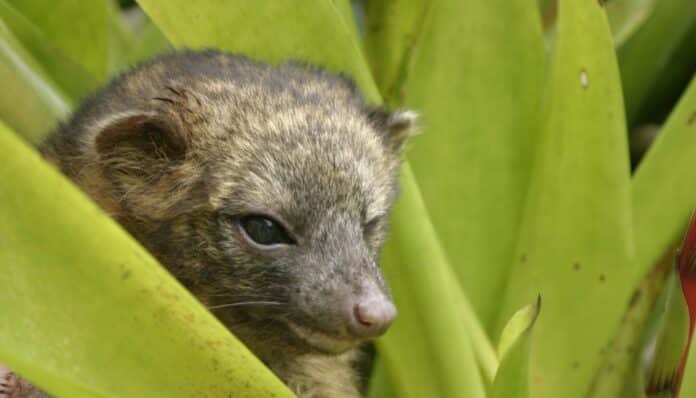
The olinguito, Bassaricyon neblina, did not need a new expedition to be found. In 2013 Smithsonian researchers realized that specimens kept in natural history museums for decades had been mislabeled as other members of the raccoon family, and one olinguito had even been shown in a zoo under the wrong name.
The team compared skins, skulls, historical records and genetic evidence before confirming a distinct species. Fieldwork then showed that olinguitos live in the cloud forests of Ecuador and Colombia.
A Balrog in the tunnels
In 2026 researchers described a new cave cricket living in artificial tunnels on the Greek island of Kastellorizo. It belongs to a group of insects adapted to dark, damp underground spaces, and the tunnels provide the island’s accessible cave habitat.
The species was named Dolichopoda balrogi, after the Balrog, the creature from J. R. R. Tolkien’s The Lord of the Rings that is tied to deep underground passages. Its discovery shows that human made tunnels can shelter animals people would expect only in natural caves.
A moth that flew in from Guyana
In 2024 a young ecologist noticed an unfamiliar moth inside her family’s home in Port Talbot, Wales. Her photos reached specialists at London’s Natural History Museum, who examined specimens and used DNA to identify a new clearwing moth, Carmenta brachyclados.
The moth’s native range is Guyana, thousands of miles away. It most likely traveled in a photographer’s luggage, inside a boot bag brought back from Guyana that held plant material and pupal cases.
A fish revealed by TikTok
In 2024 researchers in India saw a TikTok clip of a small, translucent fish coming out of a borewell near the India and Nepal border. It looked nothing like the fish usually found in surface water, so they went looking and collected specimens from underground wells in Bihar.
In 2026, genetic and anatomical work showed it was not only a new species but part of a previously unknown genus. Pale and nearly eyeless, adapted to life underground, it was named Gangaichthys indonepalicus, all thanks to an ordinary video.
Based on reporting by Listverse
By Rachel Dunbar | Geography