
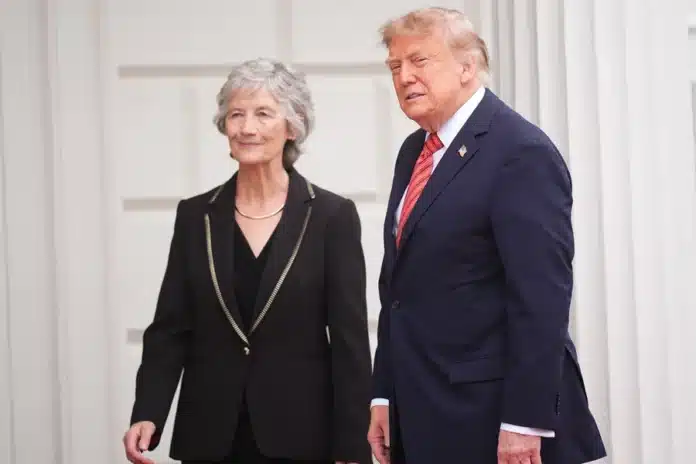
There were no cameras in the room. Ireland’s President Catherine Connolly and US President Donald Trump sat for more than twenty minutes at Áras an Uachtaráin on Saturday, and when it ended her office released what she had told him — including a line that no Irish president has put to a sitting American president in quite this way.
What we know so far
- When and where: Saturday, Sept. 12, 2026, at Áras an Uachtaráin in Dublin’s Phoenix Park.
- Format: a courtesy call running over 20 minutes, with anthems, an inspection of the guard of honour and a signing of the Distinguished Visitors Book — but no video cameras inside the meeting room.
- The line that travelled: Connolly told Trump “the normalisation of war and genocide can never be accepted.”
- Her framing: centuries of Irish-American connection are what make plain speaking possible, not what makes it rude.
- Also raised: the United Nations, Ireland’s constitutional duty to peaceful settlement of disputes, Irish emigration, the 25th anniversary of 9/11 and the 250th of American independence.
The account of the meeting was reported by Ireland’s public broadcaster RTÉ and carried by the Belfast Telegraph, drawing on the statement issued by the President of Ireland’s office.
What she actually said
Connolly did not open with the confrontation. She opened with the relationship.
“This is a deep connection, built over centuries, which allows us to speak openly.”
That sentence is doing structural work. It sets up everything after it as something said between friends rather than across a divide — the diplomatic equivalent of earning the right to the next line.
On the substance, her office said she conveyed the view of the Irish people that “the normalisation of war and genocide can never be accepted,” and drew on Ireland’s own history of suffering and its route out of it.
She also put Ireland’s institutional position on the record. “I highlighted to President Trump the strong commitment which the Irish people have to international relations, to the importance of the United Nations,” she said, alongside the obligations written into Ireland’s Constitution toward the peaceful resolution of international disputes.
And she left a door open, saying the Irish people “would strongly support all those who have the strength to build a shared peace.”
A contested word, used deliberately
“Genocide” is not a neutral term, and Connolly’s use of it puts her on one side of an argument that is live in courtrooms and parliaments.
Israel rejects the characterisation of its campaign in Gaza outright, and so do a number of Western governments. A case brought by South Africa is before the International Court of Justice, which has issued provisional measures but has not ruled on the underlying genocide allegation — a process that takes years.
Connolly’s phrasing is worth reading precisely. Her office described her objecting to the normalisation of war and genocide, framed as the strong view of the Irish people. It is a statement of national position, not a legal finding, and it lands in a dispute that no court has yet settled.
The constitution she was quoting
When Connolly’s office cited “the obligations contained within Ireland’s Constitution towards the peaceful resolution of international disputes,” it was pointing at something specific rather than reaching for a phrase.
Article 29 of Bunreacht na hÉireann opens by affirming Ireland’s devotion to international peace and its adherence to the principle of the pacific settlement of international disputes. It is the constitutional root of Irish neutrality, and it is why an Irish head of state raising war and international law with a visiting president is acting inside the job description rather than stretching it.
The presidency is largely ceremonial — it does not set foreign policy, which belongs to the government. What it carries is the power to state the country’s values out loud. Connolly used exactly that, and nothing more.
Who Catherine Connolly is
This is not a president who arrived at the office through a party machine. Connolly sat as a left-wing independent TD before her election, and she has been openly critical of Trump for years — on the record calling him “volatile” and accusing him of “acting like a bully.”
Which makes the tone of Saturday notable. There was no walkout and no public rebuke on camera. There was a formal welcome, a private conversation, and afterwards a statement that said exactly what had been raised. That is a deliberate choice about how to disagree with a head of state you have to keep working with.
The rest of the conversation
The meeting was not only about war. The two presidents discussed the contribution of Irish emigrants to the United States, the 25th anniversary of the September 11 attacks, the approaching 250th anniversary of American independence, and the American role in the Northern Ireland peace process through the International Fund for Ireland — a reminder, placed in the middle of a tense meeting, that US involvement in Irish affairs has a peacemaking chapter too.
The gifts carried the same message. Connolly gave Trump a St Brigid’s Cross, a copy of Navigatio Sancti Brendani — The Voyage of St Brendan, and the collected poems of Michael Longley, a poet of the Northern Irish peace generation.
What happens next
Watch for two things. The first is whether the White House responds to the substance at all — a courtesy call that produces a genocide reference usually gets an answer, or a pointed silence, and either is informative. The second is whether other small EU states follow Connolly’s template: say it privately, publish it afterwards, and let the written statement do the confrontation the cameras were not allowed to film.
For Ireland, the calculation is delicate. It hosts enormous American corporate investment and depends on that relationship. Saturday was a test of whether a country can say the hardest possible thing to Washington and keep the rest of the arrangement intact.
Based on reporting by RTÉ and the Belfast Telegraph
By Marcus Bell | Breaking News