
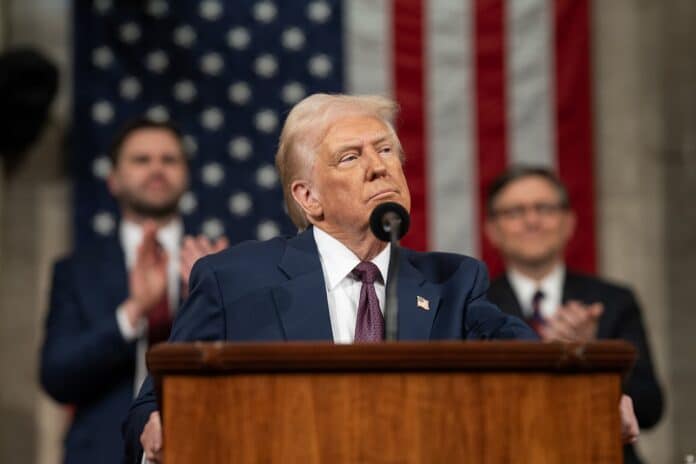
A forensic psychologist who studies body language says he has spotted something in President Donald Trump’s right arm that keeps repeating itself on camera — and he is willing to put words like Alzheimer’s, Lewy body dementia and Parkinson’s next to it. He has never examined the president. The last physical exam on the official record reached a very different conclusion.
What we know so far
- Who: Dr. John Paul Garrison, a clinical and forensic psychologist who specializes in body language and comments on politics online.
- What he says he saw: a minor spasm on the right side, showing up repeatedly at moments when Trump was not speaking.
- Where: two recent events — a White House meeting with business leaders, and a press conference about the new helipad on the South Lawn.
- What he floated: neurodegenerative disease or post-stroke brain damage — possibilities, not a diagnosis.
- The other side: the White House did not respond to the reporter’s questions, and the president’s May 2026 physical called him in “excellent health” with a perfect score on a cognitive test.
The analysis was first written up by The Daily Beast, in a piece by reporter Annabella Rosciglione published on Aug. 24, 2026, and syndicated to Yahoo News the same day. Garrison had already argued, over the past year, that Trump has gone through an accelerated cognitive and physical decline that age alone does not explain.
What the psychologist says he saw
Garrison went through footage from the two events frame by frame and pointed at the president’s right arm during the stretches when someone else had the floor.
“As you can see, President Trump seems to have a distinct spasm on one side,” he said while playing the clip.
He was specific about the pattern. “Now, it did appear that there was a distinct right-side spasm. It happened repeatedly over the course of the first meeting as well as the press conference outside,” Garrison said.
The movement he is describing — a sudden, quick, involuntary muscle jerk — is what clinicians call myoclonus. The National Institute of Neurological Disorders and Stroke describes it as a clinical sign rather than a disease in itself: something that can turn up in healthy people, in medication side effects, and in serious neurological conditions alike.
The names he put on the table
This is the part that traveled. Garrison did not stop at describing the movement; he listed what can cause it.
“What this could mean is this could be neurodegenerative disease. We could be talking Alzheimer’s, we could be talking Lewy body dementia, you could be talking something like Parkinson’s disease.”
He added a second possibility: the spasms “could also come with post-stroke behavior. There can be damage to certain areas of the brain that can cause this, but we are seeing something distinct, and it appears to be involuntary.”
Lewy body dementia, per the National Institute on Aging, affects movement, thinking and attention, and is often mistaken for Parkinson’s or Alzheimer’s in its early stages. Note the verb tense Garrison used throughout: could. He named categories of illness, not a finding.
Why he thinks agitation feeds it
Garrison’s second observation was behavioral rather than medical. He said Trump “consistently” appeared “quite impatient when other people are speaking,” and argued that the mood and the movement are connected.
“He feels agitated, and that’s going to add to the likelihood we’re going to see more of these spasms,” Garrison said.
That claim is at least directionally consistent with the medical literature: involuntary jerks of this kind are commonly reported to worsen with stress, fatigue and stimulation. It does not, on its own, say anything about the cause.
What the official record actually says
Here is the context the viral clips almost never carry. Trump had his annual physical at Walter Reed National Military Medical Center on May 26, 2026, and the White House released the physician’s memo three days later.
Navy Capt. Sean Barbabella, the president’s physician, wrote that Trump “remains in excellent health, demonstrating strong cardiac, pulmonary, neurological, and overall physical function.” The memo says he “scored a 30 out of 30 on a cognitive assessment” — a perfect result on a screening test built to catch exactly the kind of impairment Garrison raised. You can read the coverage of that memo at ABC News.
Two of the other symptoms circulating online also have official explanations attached. The memo noted “slight lower leg swelling was noted, with improvement from last year,” tied to the chronic venous insufficiency the White House disclosed in July 2025 — a common vein condition in older adults. The bruising on his hands was attributed to frequent handshaking while taking aspirin.
None of that addresses an arm spasm. The White House simply did not answer when asked about one: “The White House did not immediately respond to the Daily Beast’s inquiry about the president’s apparent arm spasms.”
Why a video is not a diagnosis
Garrison has not treated Trump, examined him, ordered a scan or seen a chart. He is reading pixels.
That matters more than it might sound. The American Psychiatric Association’s Goldwater Rule has held since 1973 that it is unethical for a psychiatrist to offer a professional opinion on a public figure they have not personally examined. Garrison is a psychologist rather than a psychiatrist, so the rule does not formally bind him — but the reasoning behind it applies to anyone diagnosing from a screen.
A single-frame twitch can be a muscle cramp, a medication effect, a nerve impingement, cold, caffeine, fatigue, or nothing at all. Neurologists identify myoclonus by cause using an exam, patient history, blood work, EEG or imaging — not footage. Read Garrison as a hypothesis worth asking the White House about, not as a result.
The longer list of questions
The spasm claim landed on top of a pile of others that have followed Trump through this term: severely bruised hands, perpetually swollen ankles, a neck rash, slurred speech, repeated confusion, falling asleep in public, and sleepless nights spent rage-posting online. Some have official explanations. Some do not. The volume is why every new clip travels so fast.
What happens next
Two things would change this story. The first is a White House answer — the press office has not addressed the arm movements, and a one-line response from the president’s physician would settle far more than another video breakdown ever will. The second is Trump’s next physical — he has gone to Walter Reed twice in the past year — because that is the next moment when a doctor who has actually examined him puts his neurological status in writing.
Until one of those lands, this remains what it started as: an outside observer with a video player, a list of conditions he cannot rule out, and an official record that says the opposite.
Based on reporting by The Daily Beast
By Marcus Bell | Breaking News