
Every Thanksgiving leaves somebody with too much turkey. In early 1953, after a holiday when the birds did not sell, the Nebraska company C.A. Swanson and Sons was left holding some 520,000 pounds of it, or 260 tons.
What the company did with all that meat put a three-part aluminum tray in front of millions of American television sets. Who actually thought of it is an argument that has never been settled.
Ten rail cars that could not stop moving
Swanson was already a well known name for frozen poultry and chicken pot pies. To keep its turkeys from thawing, it loaded them into 10 refrigerated railway cars.
There was a catch. The cooling on those cars worked only while the cars were rolling. So the company sent the trains back and forth between its Nebraska headquarters and the East Coast while executives tried to come up with a plan.
The salesman and the tray
In the best known version of the story, the answer came from Gerry Thomas, a Swanson salesman a few years into the job and earning $200 a month. He said he had seen aluminum trays meant for frozen food while visiting a distributor’s warehouse in Pittsburgh.
Thomas said he sketched a tray with three compartments that could work for both cooking and serving, then showed it to his bosses. The trays were filled with turkey and gravy over cornbread dressing, frozen peas and sweet potatoes.
For his part, Thomas said, he received $1,000 and a promotion.
Not everyone remembers it that way. Several people inside the company and the Swanson family credit the brothers who ran it, Gilbert and Clarke Swanson, with both the tray and the name. One account says Gilbert got the idea from an airline food tray while flying to see his banker. Another, from author Jack Mingo, says the name came to Gilbert after a party where guests balanced plates on their laps while watching television.
Dinner in 25 minutes for 98 cents
The Swanson TV Dinner reached grocery store cases on September 10, 1953. The box was designed to look like a small television set, tuning knobs included, and the price was 98 cents with a promise of “dinner in 25 minutes.”
The marketing was aimed at women who worked outside the home, or who simply wanted a night off from cooking. It landed. Swanson sold more than 10 million in 1954 and 25 million the year after that.
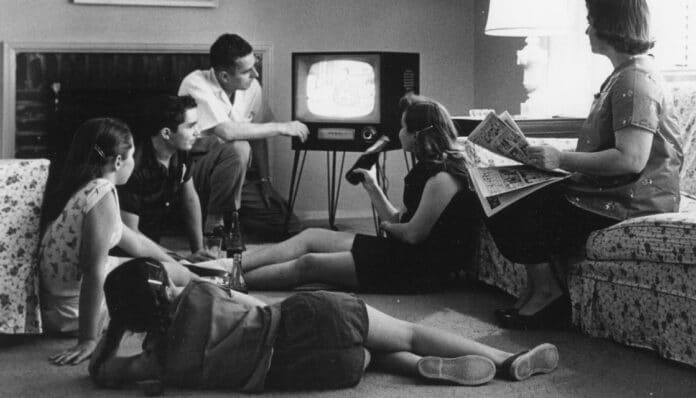
Before long, families were eating Salisbury steak or pot roast in front of “I Love Lucy” and “Gunsmoke,” and companies such as Stouffer’s and Banquet had joined in. The habit of eating in front of the set, rather than around the dining room table, came along with the tray.
Also read: Thanksgiving Dinner for 10 Costs $58.63 in 2026, and Turkey Drove Most of the Rise
Test yourself
How much have you picked up so far?
3 quick questions on what you have read so far. The story continues below.
Swanson was not the first
The frozen meal had been warming up for decades before Swanson gave it a name. Here is the short version of what came earlier:
- 1925: Clarence Birdseye developed a way to freeze fish quickly, after learning about food preservation while living among the Inuit in Canada.
- 1944: Maxson Food Systems made "Strato-Plates," a divided plate of meat, vegetable and potato that was reheated aboard military and civilian planes.
- 1947: Jack Fisher put frozen meals in aluminum trays, called them "Fridgi-Dinners" and sold them to bars and taverns.
- 1949: Brothers Albert and Meyer Bernstein founded Frozen Dinners Inc. and sold straight to shoppers in the Pittsburgh area, under the One-Eyed Eskimo label.
The Bernsteins were not small. They had made more than 400,000 dinners by 1950, and by 1954 their company, by then called the Quaker State Food Corporation, had sold more than 2 million across the eastern United States.
Maxson's founder, W.L. Maxson, had meant to bring his airplane meals to ordinary shoppers too. He died before the plan got off the ground.
Birdseye's method mattered most of all. Americans had been able to buy frozen meat for nearly half a century, but slow freezing ruined its taste and texture, and few people wanted it. Even after he moved on to vegetables in the late 1930s, few homes and few stores had the equipment to keep the food cold.
The woman who made it edible
One contributor is not in dispute. Betty Cronin was a 21-year-old bacteriologist, new at Swanson, when she was handed the problem of making the meals taste good.
Her main task was to design dinners in which every part would be hot and ready at the same moment, and would still look appetizing. Fried chicken gave her the most trouble. She told the Chicago Tribune in 1989 that the challenge was finding a breading that stayed on through freezing without turning greasy and still tasted right.
Cronin and her friends ate the failures during late nights of testing until she solved it. The experience left its mark. "I've never had a TV dinner in my home," she told the paper.
Also read: The U.S. Banned Sliced Bread in World War II, and 6 More Foods That Were Once Illegal
Based on reporting by HISTORY
By Trivia News Staff | Culture