
Charles Hatfield never claimed that he made rain. “That would be an absurd claim,” he once said. “I simply attract clouds, and they do the rest.”
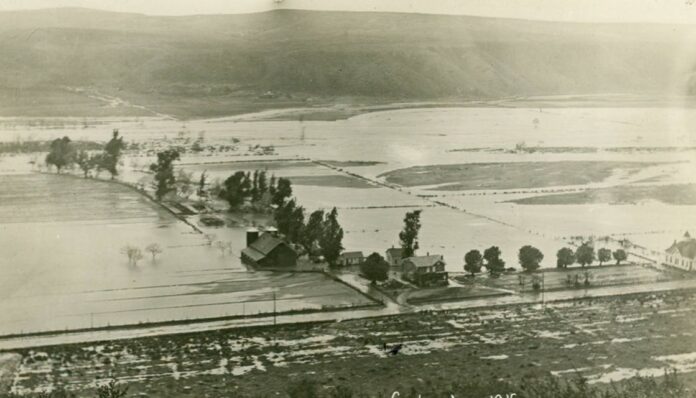
The city of San Diego took him at his word. Officials hired him in 1915 to fill a reservoir, and early in 1916 the clouds arrived, followed by about 30 inches of rain in two months, a burst dam and $3.5 million in damage.
A sewing machine salesman with a hobby
Charles Mallory Hatfield was born in Fort Scott, Kansas, on July 15, 1875. His father owned a sewing machine agency, and he and his brothers learned to repair the machines. The family moved to Minnesota and then to California, and Hatfield grew up to sell sewing machines himself.
Rain was what interested him. He studied what was then called pluviculture, the supposed science of making it, and settled on a mixture of 23 chemicals. From a windmill tower on his parents’ ranch in Gopher Canyon, near San Diego, he began to test it.
He preferred to be called a “moisture accelerator.” His usual method was to build a tower, climb it and let the mixture evaporate into the sky, with his brother Paul there to help.
An inch of rain for $50
Hatfield set out to earn money from it in 1904. Los Angeles was having a dry spell, and he offered to bring an inch of rain for $50. Two days later, it rained.
Word got around. In 1907 he worked for farmers in Oregon, and the year after that for grain growers in the San Joaquin Valley. Requests followed from Texas, Idaho, Kansas and Arizona.
Test yourself
How much have you picked up so far?
3 quick questions on what you have read so far. The story continues below.
The bargain over Morena Reservoir
San Diego had a brand new reservoir called Morena, about 60 miles east of the city. What it did not have was enough water to fill it.
The deal was simple. If Hatfield could fill Morena by the end of 1916, the city would pay him $10,000. He went up in January, put together his towers and released the mixture.
Rain began on January 5. It did not let up.
Also read: The 1936 Heat Wave Pushed Kansas to 116 Degrees and Got Shorts Legalized in Yonkers
The month the trains stopped
Morena filled quickly, and the water kept coming. The damage showed up everywhere:
- roofs leaked and storm drains clogged
- rivers left their banks
- five feet of water ran through downtown San Diego
- flooded rail lines cut the city off by land
For more than a month, goods had to come in by boat. The worst of it was in the Tijuana River Valley. Lower Otay Dam gave way and sent a 40-foot wall of water toward the people living below, killing nearly two dozen.
Hatfield described the job as "the most potent test I ever made."
No payment, and a bill for $3.5 million
City officials were furious. The reservoir was full, as promised, but they would not pay the $10,000. They told Hatfield that he ought to pay the city for the $3.5 million in damage instead.
He spent years trying to collect. The argument dragged on until the 1930s, when he dropped his case without having received a cent.
The disaster became known as Hatfield's Flood, and it did wonders for his name. He came out of it more famous than he had ever been.
Work in Canada and Honduras
In Alberta, Canada, he was paid $2,000 for every inch of rain, and his work in 1921 brought him $8,000. Eight years later he was credited with bringing the rain that saved a burning banana plantation in Honduras.
Hollywood got to the story eventually. His life was an inspiration for the 1956 movie "The Rainmaker," starring Burt Lancaster and Katharine Hepburn. By then Hatfield was past 80 and long retired.
The 23 ingredients nobody wrote down
Hatfield died on January 12, 1958, at the age of 82. People still disagreed about him. Some thought he could pull water out of the sky. Others said he was a con man whose real skill was reading the weather.
Reporters went to his brother Paul for the recipe. If anyone knew what went into the mixture, it would be the man who had helped him work.
He had nothing to give them. "He didn't ever tell," Paul said.
Also read: A Bet Over One Cocktail Sent Joe Duckworth Into a Hurricane's Eye in 1943
Based on reporting by All That's Interesting
By Trivia News Staff | History