
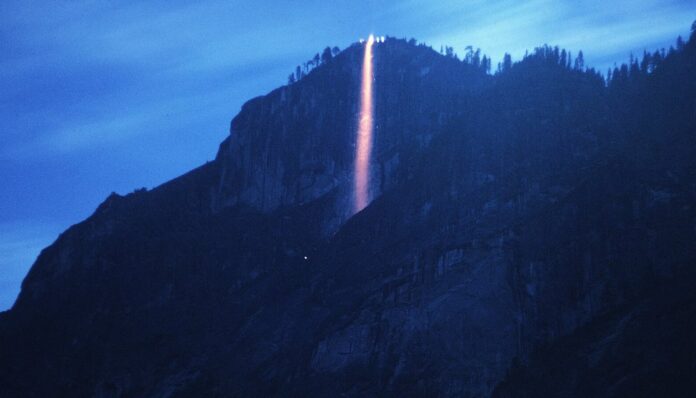
Every summer night at 9 p.m., visitors in Yosemite Valley went quiet and looked up. High above them, somebody pushed a huge pile of glowing embers off the edge of Glacier Point, and for a moment the cliff had a waterfall made of fire.
It was called the Firefall, and it was entirely man-made. It ran, with a break, from the 1870s until January 25, 1968, and it was once one of the most famous sights in any American national park.
It may have started with burning trash
White Americans are not known to have entered Yosemite Valley before 1851, when they burned Indigenous villages and forced the survivors onto a reservation. Tourists followed within a few years, and President Abraham Lincoln signed a bill in 1864 that set aside the valley and a grove of giant sequoias for “public use, resort and recreation.”
The bill kept out logging, mining and farming. It did not keep out hotels, billiard halls or people with something to sell.
One of them was James McCauley, born in Ireland, who ran a hotel at Glacier Point and a toll trail down to the valley that still exists. The details are murky, but he is believed to have pushed the first embers over the edge for a Fourth of July celebration in 1872.
Author Jen Huntley suspects he was only burning garbage, as people did then. “And then someone down below was like, ‘That was really cool. Do that again,'” she says. Before long people were paying to watch.
“Let the fire fall”
McCauley lost his lease in 1897 and the fire went out. It came back thanks to David and Jennie Curry, who founded Camp Curry in 1899. The Currys also tried to build a golf course in the valley and to dam its waterfalls, and failed at both.
Under them the Firefall became a nightly event in summer and a regular one the rest of the year. David Curry died in 1917, and the show went on without him. The routine rarely changed:
- in late afternoon a bonfire of red fir bark, said to make the best embers, was lit on Glacier Point
- by 9 p.m. it had burned down to a great heap of red coals
- from the valley the host shouted, “Hello Glacier Point, is the fire ready?”
- the fire master called back, “The fire is ready”
- the host answered, “Let the fire fall,” and the coals were raked over the edge
In later years the crowd at Camp Curry sang “Indian Love Call,” a tune from a Broadway musical, while the fire came down. “America the Beautiful” found its way into the evening as well.
Test yourself
How much have you picked up so far?
3 quick questions on what you have read so far. The story continues below.
A movie star and a president
The Firefall turned up on postcards and on fruit labels. It appears in the 1954 film "The Caine Mutiny," with Humphrey Bogart.
President John F. Kennedy watched it too. That may have been the only night it ran late, since it was held past 9 p.m. to suit his schedule.
At the top, the drop was no joke. A sign at Glacier Point warned visitors about the cliff and promised there was "no undertaker to meet you" at the bottom.
Also read: The Grand Canyon Is Not the Deepest Canyon in the U.S., and 10 More Surprises
Horns on a rabbit
Throwing live coals off a cliff in a forest was not everyone's idea of safety. Red fir bark was also getting harder to find around Glacier Point after so many bonfires.
The bigger trouble was down below. Cars poured in, and people drove straight onto the valley's fragile meadows and parked there.
George Hartzog Jr. became director of the National Park Service in 1964 and decided the show belonged in an amusement park. "It was a spectacular sight, but as appropriate to the majesty of Yosemite Valley as horns on a rabbit," he wrote in his memoir.
The last Firefall came on January 25, 1968, with little fuss. Around the same time the park service stopped feeding bears for the public.
The fire it may have helped start
In nearly 100 years, the Firefall is not known to have set off a single major forest fire. The bark it left behind has a less clean record. Fir bark that had been gathered and never used reportedly fed the blaze that destroyed the Glacier Point Hotel in 1969.
There was an irony in it as well. While officials promoted one fire for tourists, they stamped out fire everywhere else, a policy that led to worse wildfires later.
Also read: Mount Rushmore Was Supposed to Have Torsos, and 11 Other Landmark Secrets
Nature put on its own version
Five years after the coals stopped, photographer Galen Rowell caught something on the other side of the valley. In 1973 he photographed Horsetail Fall on El Capitan, lit orange by the setting sun.
That is the sight people call the Firefall now. It lasts one to five minutes in the late afternoon, for about two weeks in February, and only when the sky is clear and the water is running. One photographer said it looks like lava, and this time nobody has to carry the bark up the mountain.
Based on reporting by HISTORY
By Trivia News Staff | Landmarks