
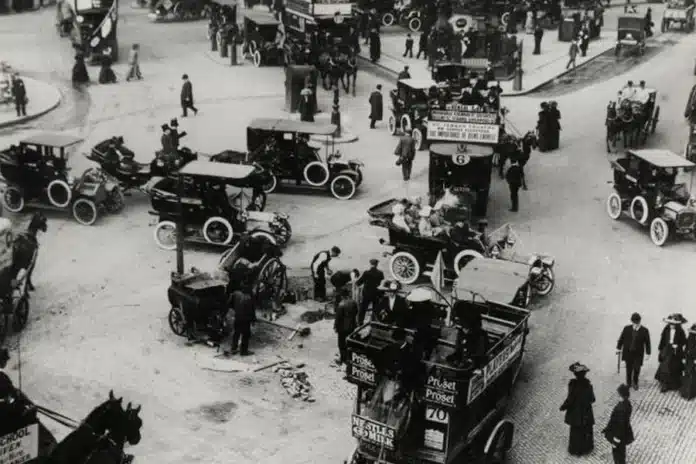
Old photographs do more than show us funny hats and horse-drawn carts. Look closely at a street scene from the 1800s or early 1900s and you get a quiet time capsule — proof of how a city grew up, tore itself down, and rebuilt. Some places are almost unrecognizable a century later. Others look eerily frozen in time.
Could you pick out a photo of Sydney taken before the Opera House existed? Do you know how a chunk of an actual London bridge ended up baking in the Arizona desert? Below, five world-famous cities shown “then and now” — and the surprising stories hiding in the details.
1. London, United Kingdom — Then (around 1890)
This chaotic scene on London Bridge was captured somewhere between 1890 and 1900. That tall fluted Doric column rising on the left is still standing today — it’s the Monument to the Great Fire of London, marking the blaze that tore through the city back in 1666. Just beside it, you can spot the steeple of St. Magnus-the-Martyr church, which at the time sat right at the foot of the bridge.
But the real showstopper is the sheer crush of humanity: packed commercial carts, working horses, and a sea of bowler hats and top hats all pouring across the River Thames at once.
London Now (2017)
Fast-forward 120-odd years and this corner of London is almost impossible to place. The “urn of fire” atop that same Great Fire monument still peeks out — this time from behind Adelaide House, the big rectangular office block. Around it sprawl the modern towers, including the unmistakable curved silhouette of 20 Fenchurch Street, nicknamed “The Walkie-Talkie.”
A red double-decker rolling across the bridge instantly dates the shot. And if you have a sharp eye, you’ll notice the bridge itself looks completely different — because it is. The Victorian version had to be replaced in the 1960s with a structure built for modern traffic. Here’s the wild part: the City of London sold the old bridge, an American businessman bought it, and its exterior stonework was shipped overseas and rebuilt as part of a new bridge in Lake Havasu City, Arizona.
2. Sydney, Australia — Then (around 1950)
Shot from the Circular Quay West area, this view of Sydney is easy to date thanks to one detail: the aircraft carrier in the water places it just after World War II, in the late 1940s. Back then, the Sydney Harbour Bridge — visible on the left — was the undisputed icon of the city.
That wouldn’t last. In 1959, Sydney broke ground on a structure destined to become one of the most recognizable buildings on Earth: the Sydney Opera House, which finally opened its doors in 1973.
Sydney Now (2016)
Taken from nearly the same vantage point roughly 70 years later, the bones of the scene remain — the bridge and several surrounding buildings are still intact. But the wartime aircraft carrier has been swapped for an enormous cruise ship, the kind that unloads waves of tourists at the Overseas Passenger Terminal every single day.
That sand-colored brick façade? It’s the former Maritime Services Board building, which today lives a second life as the Museum of Contemporary Art (MCA).
3. Valencia, Spain — Then (around 1920)
This is the old Port of Valencia, a city hugging Spain’s eastern Mediterranean coast. Dominating the background is the Clock Building, completed in 1916 — a clear nod to the French architectural influence that shaped the region.
Even in the early 20th century, Valencia was already a heavyweight for exports, which explains the crowded, bustling port where horse carts, streetcars, and ships all jockeyed for space.
Valencia Now (2022)
A century on, both the port and its landmark clock tower are as vital as ever. But look closer and you’ll spot the difference: the building now has far more windows and doors. As the city and its port exploded in size through the mid-20th century, the home of the Valencian Port Authority needed room to grow, so its interior and exterior were expanded over the decades. Crucially, the neoclassical details were preserved out of respect for their cultural and historical value.
4. Paris, France — Then (around 1890)
You barely need the Eiffel Tower to know this is Paris. The distinctive Haussmann-style architecture gives it away — the product of Baron Haussmann’s sweeping overhaul of the city between 1853 and 1870, which swept away the cramped medieval alleys and replaced them with the wide, airy boulevards Paris is famous for. This particular corner was a favorite subject of 19th-century street photographers.
Paris Now (2011)
Remarkably little has changed on these building façades. The intersection of Rue Montmartre and Rue du Faubourg Montmartre would look almost identical if not for the modern cars and freshly paved streets.
More recently, in the 2020s, many of the smaller side streets branching off this junction have seen growing pedestrianization and traffic limits, with some converted into low-speed “Meeting Zones” that put people ahead of cars.
5. Venice, Italy — Then (around 1880)
Because Venice guards its façades so fiercely, dating its old photos can be tricky. But here the water gives us a clue: its still, slightly blurred surface points to the long-exposure photography common in the late 1800s.
The grand buildings on the right are the Ca’ Foscari and the Palazzo Giustinian — both stunning examples of Venetian Gothic architecture from the 15th century, standing watch over the Grand Canal.
Venice Now (2021)
Don’t let the missing gondolas fool you — those slender rowing boats remain as iconically Venetian as ever, and any visitor will catch plenty. But the sleek modern motoscafo (water taxi) slicing through the green canal is a dead giveaway for the 21st century.
The same buildings still stand, their intricate detailing beautifully preserved. Even the paline — those striped wooden mooring poles — have barely budged over the decades.
By Eleanor Hayes | History & Travel