
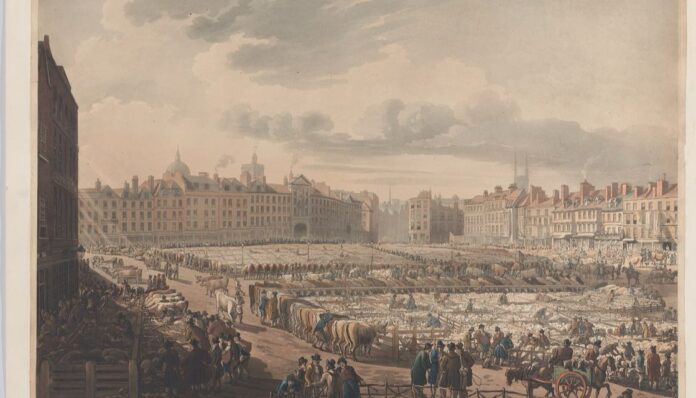
London has a new museum that calls itself the largest city museum in the world, and it opens to the public today, Saturday, November 28. The London Museum has moved into the Victorian buildings of the old Smithfield meat market after a refurbishment that cost 437 million pounds, about $573 million.
Its collection runs from a Roman mosaic to a bloodstained shirt and a chunk of hardened sewer fat. It replaces the old Museum of London, which stood half a mile away, was famously hard to find, and closed in 2022.
A better address
The old museum had sat since 1976 in a windowless brick building, surrounded by traffic and reached by elevated walkways. It still drew 700,000 visitors a year, transformation director Alec Shaw told The Guardian, “but they wouldn’t come back.”
The new site sits between the financial district of the City of London and the creative Clerkenwell area. Next door is the working wholesale meat market, which is due to move away by 2030 after more than 800 years on the site.
The building is a sight of its own. The general market opened in 1883 and was the last of three Smithfield market halls designed by City architect Horace Jones, who also designed Tower Bridge. Its great dome rises over the former trading hall, held up by decorative iron columns and roofed with vaulted skylights.
Opening its doors early and late
The museum wants to feel like a market, not a quiet gallery. It has at least four entrances, no tickets and no bag checks.
On Friday and Saturday nights it stays open until midnight, with DJs in the main hall. Mornings start at 7 a.m. with a ring of the last bell cast at the Whitechapel foundry, just as the meat traders next door finish their shift.
Test yourself
How much have you picked up so far?
3 quick questions on what you have read so far. The story continues below.
From Buckingham Palace to Banksy
The ground floor, in the old trading hall, covers the London people remember. Highlights include:
- The gilded State Coach used by the Lord Mayor of London
- The old telephone switchboard from Buckingham Palace
- A police sentry box that the street artist Banksy covered with piranhas in 2024
- Signs from an Odeon cinema, the closed Walthamstow greyhound stadium and the local fried chicken chain Morley's
A temporary exhibition looks at London food, including Brick Lane, a street that has been home to Jewish delis, South Asian curry houses and now char siu bagels, a pork-filled mix that reflects the area's many Chinese students.
Also read: Galileo's Middle Finger, Chopin's Heart and 13 More Body Parts You Can Still See
2,000 years underground
The lower floor holds about 5,000 objects that trace the city from Roman Londinium through the Middle Ages, the Great Fire of 1666, the years as capital of the British Empire, and the immigration and social movements of the 20th and 21st centuries. Shaw estimates that seeing everything would take eight hours.
The mix is as varied as the city. There is a piece of the Whitechapel Fatberg, an 820-foot lump of hardened fat, oil, diapers and baby wipes found clogging a sewer in 2017. Nearby is the bass guitar Paul Simonon of The Clash smashed on the cover of the album London Calling.
The clothing includes the shirt said to have been worn by King Charles I at his execution in 1649, Queen Victoria's black mourning dress and the swim trunks of Olympic diver Tom Daley.
Jewels, fakes and passing trains
One large gallery holds the Cheapside Hoard, a cache of gold and gems from a 17th century jeweler's workshop that workmen found while demolishing a building in 1912. Among the treasures is a tiny watch carved from a single Colombian emerald crystal. There are also some very skilled fakes, a reminder that scams have long been part of city life.
At the far end of the lower floor, a 20-foot window looks straight onto railway tracks, so visitors can watch trains rush past toward nearby Farringdon station.
A pigeon for a mascot
The museum plans to grow, with underground vaults opening in 2027 and a former poultry market building added in 2028. It has four places to eat and drink, plus a gift shop full of magnets, hair clips and other souvenirs carrying its mascot, a pigeon.
A spokesperson said the pigeon is an "unlikely hero of the city," common, sometimes unloved and often misunderstood. "They're really smart, they're actually quite beautiful, and they're everywhere."
Based on reporting by the Associated Press and The Guardian
By Trivia News Staff | Landmarks