
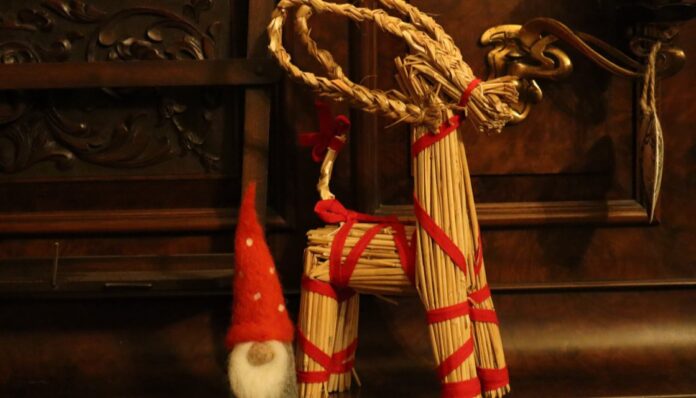
Every year since 1966, the Swedish town of Gävle has put up a 40 foot Yule Goat made of straw in its main square. It burned down at midnight on its very first New Year’s Eve, and it has been destroyed again and again in the decades since.
That goat is one of the stranger stops in Atlas Obscura’s guide to the world’s oddest Christmas traditions. European Christmas markets, the guide argues, are much alike, with the same mulled wine served from the same wooden huts. The local folklore is not alike at all. It happens on fixed dates, and much of it is a good deal darker than the season’s cheerful reputation, with more than one tradition involving children being eaten.
Gävle, Sweden: the goat that burns
The Gävle goat was dreamed up by an advertising consultant, and the chief engineer on the first build was his brother, who happened to be the town’s fire chief. Its fiery first New Year’s Eve started a tradition of its own.
Most of the goats since have been lost to arson, but not all. The record also includes a car attack and an attempted theft by helicopter. There is a live webcam on the goat, and it has its own social media accounts.
The goat stands from the first Sunday of Advent through New Year’s, security permitting. Since 2019, special street signs marking its square have stayed up all year round.
Iceland: the cat that eats children
Iceland, the guide says, has the best Christmas monsters in the world. The Yule Cat, or Jólakötturinn, roams the countryside on Christmas Eve and eats any child who is not wearing at least one new piece of clothing.
There is a practical logic hidden in that threat. It worked as an incentive, nudging children to earn new clothes through good behavior before winter set in. The cat belongs to Grýla, a witch and giantess.
Grýla’s sons are the Yule Lads, 13 of them, who arrive one per night over the 13 nights before Christmas. Their names alone are worth the trip, among them Sheep Worrier, Spoon Licker and Window Peeper. The headmaster of Iceland’s Elf School argues that the friendly modern Lads are a recent invention and that the originals were truly frightening. He also insists they are real.
They are said to live at Dimmuborgir, a field of jagged black lava towers and caves near Lake Mývatn, formed by an eruption about 2,300 years ago. The name means Dark Castles. Travelers who want to catch the Lads should go between December 12 and Christmas Eve.
Test yourself
How much have you picked up so far?
3 quick questions on what you have read so far. The story continues below.
Austria and Bavaria: chased by Krampus
Krampus is the partner of Saint Nicholas who deals with the children on the naughty list. The figure has old Alpine roots, but its modern form traces to the 16th century Counter Reformation, when Jesuit plays in Bavaria and Tyrol put a devil on stage beside St. Nicholas for the first time in European art.
The Krampus runs happen on December 5 and 6, around St. Nicholas Day, in Austria, Bavaria and South Tyrol. Costumed Krampuses march through town centers swatting onlookers with switches, and it is not put on for tourists.
The guide's tip for Americans who cannot reach the Alps is Milwaukee. The city's yearly Krampusnacht centers on the 19th century Pabst Brewery district, where a traditional drum and bugle corps leads about 100 horned figures down the street.
Central Europe has darker company still. Frau Perchta is a Christmas witch said to haunt the year's longest nights, sometimes called the female Krampus. In Poland, Turoń, a biting, dancing bull beast descended from the aurochs, still tours villages in the season.
Also read: A Storm Moved the 100th Macy's Parade to Saturday, and a Hippo Lost in 1931 Awaits
Catalonia: the figure in the manger scene
Traditional nativity scenes in Catalonia hide a figure called El Caganer, a small peasant in a red cap crouched at the edge of the manger, relieving himself. He has been part of Catalan nativities since at least the 18th century.
Nobody agrees on why. He may be fertilizing the soil for the year ahead, reminding viewers that the holy and the earthly live side by side, or simply providing comic relief. Modern versions are made in the likeness of politicians and soccer players, and finding him in a nativity scene is part of the fun.
Oaxaca, Mexico: the Night of the Radishes
On December 23, the city of Oaxaca holds La Noche de Rábanos, the Night of the Radishes. Carvers fill the main square with sculptures made entirely of radishes, from saints and buildings to musicians and copies of the Last Supper.
The radishes are huge, some 18 inches long and close to 7 pounds, and the city grows them specially so the contest stays fair. The custom began with farmers carving radishes to catch shoppers' eyes at the Christmas market, and the formal competition dates to 1897. The sculptures last only hours before they wilt.
The United States: Christmas all year long
America's contribution is Christmas as a permanent state of mind. Outside Colorado Springs, a Christmas theme park called the North Pole opened in 1956, is still run by the same family and stays open all summer.
In Leavenworth, Washington, a town that chose to become Bavarian, the Nutcracker Museum holds more than 7,000 nutcrackers from over 50 countries, including Garfield, Snoopy, an Egyptian mummy and a cast iron Jimmy Carter prototype.
The guide's closing advice is simple. Visit a market if you like, but choose the city for its traditions and put the date on the calendar first, because a market runs for six weeks and a Krampus run lasts one night.
Also read: The 2026 Rockefeller Center Tree Is 76 Feet Tall, and Its Owner Suspected a Prank
Based on reporting by Atlas Obscura
By Trivia News Staff | Culture