
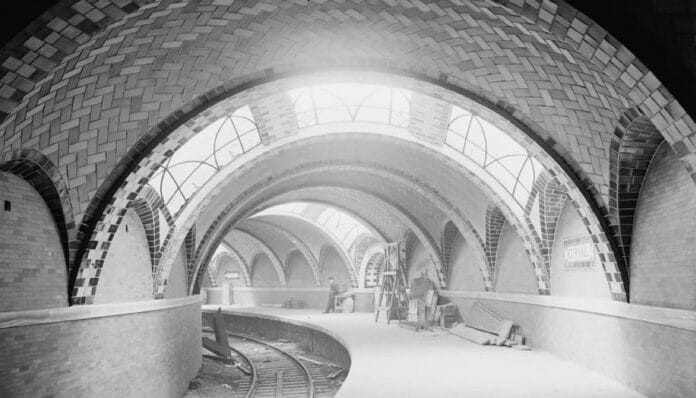
Under the streets of Cincinnati there are stations where no passenger ever boarded a train. The tunnels were dug, the platforms were built, and then the money ran out.
It is one of several American cities with a second one hidden beneath it. Some were buried on purpose, some were raised out of the mud, and at least one famous set of tunnels may never have existed.
Cincinnati’s two miles of empty subway
Voters in Cincinnati approved a $6 million bond issue for rapid transit in 1916. Construction began in 1920 along the bed of the old Miami and Erie Canal, and by 1923 about two miles of tunnel were finished.
Wartime delays, inflation, political fights and rising costs ate up the budget. By 1927 the money was gone, and the line still had no tracks, no equipment and no important connections. Then came the Depression.
The city built Central Parkway over part of the route. Below it, stations such as Race Street are still waiting for a train.
Seattle moved up a floor
In 1889 a glue pot left over a flame in a cabinet shop started a fire that destroyed 25 blocks of Seattle. Instead of rebuilding on the same muddy, flood-prone ground, city leaders raised the streets by one to two stories with retaining walls and dirt from the nearby hills.
Merchants reopened at the new height, but their old storefronts and sidewalks stayed where they were, a level down. By 1907 health officials had closed off the lower level for fear of plague. Tour guides now lead visitors through it, under glass skylights that once lit the sidewalks.
Sacramento jacked itself out of the water
Rain fell on Sacramento for weeks at the end of 1861, and by January the river had swallowed the young city. Business owners rowed through their own storefronts.
When the water went down, the city decided to get above it. Over the next decade whole blocks of downtown were raised by as much as 10 to 15 feet. Some merchants kept working below, in what had become a basement, while other buildings simply got a new front door on the second floor. Hollow sidewalks from that work can still be toured in Old Sacramento.
Also read: Florida’s Overseas Highway Crosses 42 Bridges, and 11 More Roads Worth the Drive
Test yourself
How much have you picked up so far?
3 quick questions on what you have read so far. The story continues below.
New York's most beautiful closed station
City Hall station opened on October 27, 1904, the first day of the New York subway. It was the showpiece of the line, with chandeliers, arched tile ceilings and skylights of amethyst glass.
Its platform was the problem. It was short and sharply curved, so the longer trains that came later could not fit, and the Brooklyn Bridge stop nearby drew away most of the riders. The city closed it on New Year's Eve in 1945.
It never quite went away. The No. 6 train loops through the empty station as it turns back uptown, and a rider paying attention gets a few seconds to look.
Boston's lost stops
Boston opened its first subway in 1897. The Tremont Street system once included two stations, Adams Square and Scollay Square, that vanished when Government Center was rebuilt in the 1960s.
A piece of the old tunnel survived under City Hall Plaza, and in 2018 it was opened for limited tours. The city's better known hole in the ground is the Big Dig, the project that ran from 1991 to 2007 and replaced an elevated highway with one underground. It covers about 7.5 miles, roughly half of it in tunnels.
Chicago's walk out of the cold
The Chicago Pedway started in 1951 as a short link between Red and Blue Line stations near Washington and Jackson. Developers kept adding to it.
It grew to about five miles, tying together more than 50 buildings across more than 40 blocks of the Loop. It is not one continuous tunnel, and parts of it look like any office hallway.
Los Angeles and the liquor tunnels
After Prohibition took effect in 1920, service tunnels under downtown Los Angeles found a new use. Historians agree that some of them carried liquor and connected basement businesses.
The Los Angeles Public Library notes that the city may have had twice as many speakeasies as it had bars before the ban. The King Eddie Saloon was one of the best known survivors. The popular picture of a single giant secret network, though, is an exaggeration.
Two smaller cities with a lower level
Not every buried place belongs to a big city:
- Indianapolis: The Catacombs cover about 20,000 square feet near City Market. They are the brick arches and limestone columns left under Tomlinson Hall, an auditorium that opened in 1886 and burned in 1958, and despite the name nobody was ever buried there.
- Eureka Springs, Arkansas: Around 1890, workers began filling and raising parts of Main and Spring streets to get them out of the muddy runoff. The road reached the second floor of some buildings, and the first floors ended up underground.
The tunnels that probably are not there
Mooresville, Indiana, has the legend without the hole. John Dillinger grew up in the area, took part in the attempted robbery of a Mooresville grocer, Frank Morgan, in September 1924 at age 21, and came back in April 1934 while recovering from a gunshot wound.
Stories of secret gangster tunnels grew out of those visits. No reliable source has ever established that Dillinger used such a network.
Also read: Disney World and Mount Vernon Sit Under No-Fly Zones, and So Do 8 Other U.S. Sites
Based on reporting by WanderTrivia
By Trivia News Staff | Landmarks