
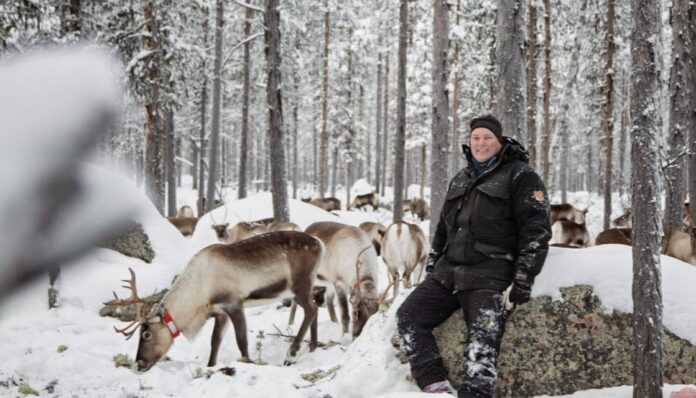
Long before Norway, Sweden, Finland and Russia drew their modern borders, the Sámi people were living across the top of Europe. They emerged about 2,500 years ago in a region they call Sápmi, and by the 17th century many of them were following huge domesticated reindeer herds across the Arctic.
Today an estimated 80,000 to 100,000 Sámi still live in Sápmi, which covers northern Norway, Sweden and Finland along with Russia’s Kola Peninsula. Only a small share still herd reindeer, but their story is one of the most remarkable in European history.
A life built around reindeer
The Sámi traditionally lived by hunting, fishing, foraging and keeping small flocks of sheep and reindeer. The reindeer gave them almost everything they needed: milk, meat, clothing and transportation.
In the 14th century, the group split into two branches, the “Sea Sámi” and the “Mountain Sámi.” Some experts think the bubonic plague caused it. The disease reached Norway around 1349 and killed so many farmers and fishermen that Sámi men were recruited to take over their coastal homesteads.
Under that theory, the people who moved to the coast became fishermen along the fjords, while those who stayed inland kept herding. Over time the Mountain Sámi built up large domesticated herds and followed the animals along their migration routes every year.
Test yourself
How much have you picked up so far?
3 quick questions on what you have read so far. The story continues below.
Pushed off their land
That semi-nomadic way of life left the Mountain Sámi exposed when Scandinavian settlers began moving north in the 17th century. In the 1630s, the Swedish government tried to force Sámi people to work in silver mines, and many fled land their families had lived on for generations.
The witch trials sweeping Europe reached them too. In 1693, a Sámi man named Lars Nilsson was burned at the stake for idolatry. According to the Swedish magazine Släkthistoria, he had been reported for singing and playing his drum after his young grandson drowned. He was performing a joik, a traditional Sámi chant, in an attempt to bring the boy back to life.
About 20 years later, a Lutheran missionary named Thomas von Westen arrived in Sápmi. Known as the "Apostle of the Sámi," he converted many people who had long followed a polytheistic, animist faith.
Schools without their language
By the late 19th century, Norway required every child in the country to attend school for seven years. Sámi children went too, but they were forbidden to speak their own languages in class, and Sweden and Finland banned Sámi languages in their schools as well.
The pressure grew in the 20th century. Norway passed a law requiring anyone who wanted to own or lease land to prove they knew Norwegian. Many Sámi left, and those who stayed slowly lost pieces of their culture.
Mines, turbines and grazing land
Meanwhile, Nordic governments kept granting permits to logging, mining and oil drilling companies on Sámi land, and that has continued into recent years. A few examples of the pressure on reindeer country:
- In 2010, Sweden approved a massive wind farm on land where Sámi herds graze each winter
- Finland's government maintains that the Sámi have no legal ownership of lands they have lived on for centuries
- NATO carries out bombing practice across Sápmi, which disrupts reindeer migration
Those who do still herd have adopted modern technology, which has made the lifestyle far less nomadic than it once was.
Keeping the culture alive
Despite centuries of pressure, the Sámi have worked hard in recent decades to protect their identity. In 1986 they adopted their own flag and national anthem, and today Finland, Norway and Sweden each have a Sámi parliament where elected members speak for their people.
Tourism is a mixed blessing. Finland has turned Sámi culture into a lucrative marketing tool, with non-Sámi actors in traditional dress performing invented ceremonies. In one, visitors cross the Arctic Circle, an act that means nothing in Sámi tradition.
Sámi poet Inger-Mari Aikio described the feeling in 2022, telling the Tupelo Quarterly that her people were taught from the start that their language and culture were worth nothing and that they were only good as a tourist attraction.
Their traditions say otherwise. From melodic joiks and shamanic drums to reindeer sleds, cone-shaped lavvu tents and ceremonial clothing, the Sámi way of life has outlasted centuries of pressure, and many Sámi today are determined to pass it on.
Based on reporting by All That's Interesting
By Trivia News Staff | Culture