
Almost a century after Galileo was buried, an antiquarian and an anatomist removed his middle finger, two other fingers and a tooth, and the finger now sits in an egg shaped glass case in Florence. It is far from the only famous body part that has outlasted the rest of its owner.
Across the world, pieces of people have been kept as war trophies, revered as healing relics, displayed in honor of the dead or preserved by accident in nature. Here are 15 you can still visit, from a Yukon bar to a Maryland medical museum.
1. Lincoln’s skull fragments in Maryland
The National Museum of Health and Medicine in Silver Spring, Maryland, holds 24 million medical instruments and anatomical specimens. Among them are pieces of Abraham Lincoln’s skull with hair still attached, and the amputated leg of Gen. Daniel Sickles.
The collection also includes the skull of a Civil War soldier shot across the top of the head and one of the world’s largest collections of human and animal brains.
2. A toe in your drink in the Yukon
Long ago, miner and rumrunner Louie Linken had a frostbitten toe amputated and kept it in a jar of alcohol. Decades later a local captain found it and began dropping it into drinks at a Dawson City saloon, now the Downtown Hotel bar.
The original toe lasted seven years before it needed replacing, and donors have since supplied about a foot’s worth. Members of the Sourtoe Cocktail Club follow one rule, which is that your lips have to touch the toe.
3. Lindow Man in London
This man, about 25 years old, died sometime between 2 B.C. and A.D. 119, and the bog he was found in preserved his skin, hair and organs remarkably well. His last meal was unleavened bread made from wheat and barley.
Head wounds, broken ribs and a cut throat point to a violent death, though it is unclear whether it was murder or ritual sacrifice. He is on view at the British Museum.
4. A serial killer’s head in Lisbon
Diogo Alves, Portugal’s first serial killer and one of the last men hanged there, was executed in 1841, when phrenology was a hot new field. Phrenologists asked to keep his head, believing his skull would explain his crimes.
It did not, and by 1843 phrenology was branded a pseudoscience. The head still floats in a jar at the University of Lisbon, beside a hand made transparent for study.
5. Einstein’s brain in Philadelphia
The Mütter Museum, inside the College of Physicians of Philadelphia, keeps 2,000 objects removed from people’s throats, conjoined twin skeletons and the remains of a man who stood 7 feet 6 inches tall. Its best known holding is a set of thin slices of Albert Einstein’s brain on 46 microscope slides.
Pathologist Thomas Harvey took the brain without permission during the autopsy, since Einstein wanted to be cremated. Some scientists see something special in it, and others see ordinary tissue worn down by trips across the country.
Also read: In Longyearbyen, Norway, It Is Famously Illegal to Die, and Nine Other Odd Towns
6. St. Anthony’s tongue in Padua
St. Anthony was a celebrated preacher across France and Italy. When his body was exhumed in 1263, the one part that had not decayed was his tongue.
The tongue and jaw are kept in gold reliquaries at his basilica in Padua, a building that mixes Romanesque, Byzantine and Gothic styles and holds work by Giotto and Donatello.
7. A rotting prince in stone in France
Prince René de Chalon, who died at 25 during the siege of Saint-Dizier in 1544, asked to be remembered as a decaying corpse rather than a handsome one. Ligier Richier carved exactly that in 1547 for the Church of Saint-Étienne-le-Vieux in Bar-le-Duc.
The statue holds a heart shaped reliquary that once contained René’s real heart, which was lost or stolen during the French Revolution.
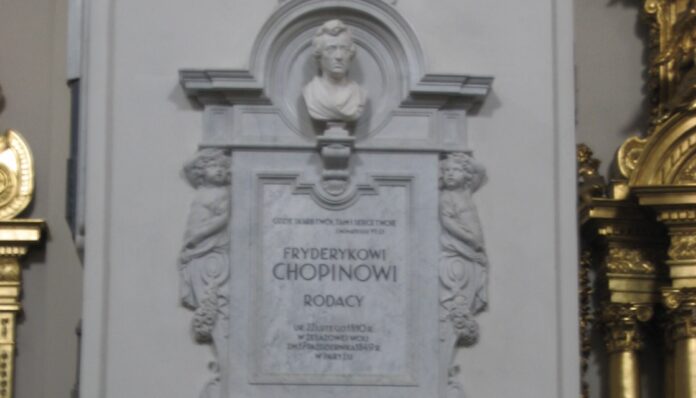
8. Chopin’s heart in Warsaw
Frédéric Chopin asked for his heart to go home to Poland instead of being buried with him in Paris. His sister, Ludwika Jędrzejewicz, removed it and smuggled it to Warsaw in a jar of alcohol.
Placed under Holy Cross Church, it became a symbol of Polish pride, so the Nazis took it during World War II to weaken morale. Germany returned it after the war.
9. St. Valentine’s shoulder blade in Prague
Holy Roman Emperor Charles IV is said to have brought the bone to the Saints Peter and Paul Basilica in the 1300s, but nobody found it until 2002, when church members came across it while sorting the basement. It now gets its own Mass on Valentine’s Day.
Many churches claim pieces of St. Valentine, so its authenticity is in doubt.
10. The Museum of Sin in Russia
Forensic pathologist Yuri Shchukin has gathered more than 700 body parts and organs in Tambov to show the damage done by vice. Exhibits include the severed finger of an unfaithful husband and a horn said to have grown from a robber’s head.
A Latin inscription at the door says this is where the dead teach the living.
11. Galileo’s finger in Florence
The finger passed to Florence’s Laurentian Library and later the Museo Galileo, which presents it as a tribute to the astronomer as a hero of science. In 2009 it was reunited with his newly authenticated index finger, thumb and tooth.
12. St. Catherine’s head in Siena
When Saint Catherine died in 1380, Siena wanted her body but knew Rome would not give it up. So her supporters cut off her head, hid it in a paper bag and slipped it past Roman guards.
It rests in an ornate reliquary at the Basilica of San Domenico, along with her thumb, while her foot is in Venice.
13. A Buddha tooth in Singapore
A huge temple complex in Singapore’s Chinatown was built to display one tooth said to be the Buddha’s, reportedly recovered from a collapsed stupa in Myanmar in the 1980s. Some experts have called it definitely not human.
The temple, with floors of Buddha statues and a grand prayer hall, is worth seeing anyway.
14. Bog bodies in Dublin
The National Museum of Ireland’s Kingship and Sacrifice exhibit displays Iron and Bronze Age sacrifices left in bogs along tribal borders. Highlights include the Cashel Man, the oldest fleshed bog body ever found, and the Gallagh Man, strangled with a rope of willow.
Visitors can also see weapons, horse gear and lumps of ancient bog butter.
15. A leg with its own grave in New Hampshire
In 1804, tavern keeper Capt. Samuel Jones of Washington, New Hampshire, had his leg crushed between a building and a fence, and it had to be amputated. He gave the leg a funeral and buried it in the local cemetery, partly to ward off phantom limb pain.
Jones himself was later buried somewhere else, with guesses ranging from Boston to Rhode Island to the Bronx. The leg’s gravestone is now set in concrete so no one can steal it.
Also read: A Town Where Stairs Were the Streets, and 9 Other Real Places Out of a Fantasy
Based on reporting by Atlas Obscura
By Jennifer Collins | Landmarks