
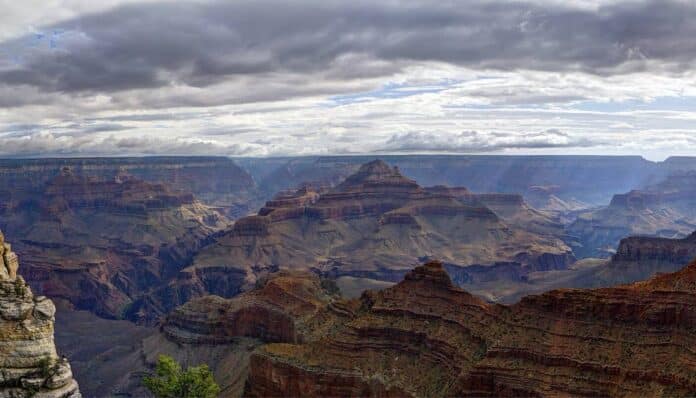
The Grand Canyon is about one mile deep, which sounds enormous until you learn it is not even the deepest canyon in its own country. Hells Canyon, cut by the Snake River along the Oregon and Idaho border, drops roughly half a mile farther.
That is only the first surprise tucked into Arizona’s most famous landmark, which Congress made a national park on February 26, 1919. Here are 11 facts that even regular visitors tend to miss.
1. It is not the world’s deepest canyon
The Grand Canyon may be the grandest, but it does not hold the world depth record. Measuring a gorge turns out to be surprisingly tricky, and depending on the method the title goes to Peru’s Cotahuasi Canyon, at more than 11,000 feet, or to Nepal’s Kali Gandaki Gorge.
2. It is not the deepest in America either
Hells Canyon claims the domestic crown. The Snake River carved it about half a mile deeper than the Colorado River managed in Arizona.
3. Nobody agrees on its age
For years the standard answer was about 6 million years. Over the last decade, though, studies of the canyon’s minerals suggested it could be closer to 70 million years old, and the debate among scientists has been lively.
One idea reconciles the two numbers. The canyon may have formed in pieces, with some sections dating back as far as 70 million years, while the single connected canyon visitors see today only took shape in the last 6 million.
Also read: Arizona and Hawaii Skip Daylight Saving Time, and Here Is Why
4. The Hopi see it as a gateway to the afterlife
The Hopi, who have long lived in the region, call the canyon Öngtupqa, and it holds deep spiritual meaning for them. They believe that after death a person travels west through the sipapuni, or place of emergence, on the way to the afterlife.
The sipapuni is a dome of mineral deposits inside the canyon, upstream from where the Little Colorado River meets the Colorado.
5. The weather changes on the way down
The North Rim stands about 8,000 feet above sea level, and hiking from there to the bottom a mile below can mean a temperature swing of more than 25°F. Summer highs on the canyon floor can top 100°F, while winter nights on the rim can fall to 0°F.
6. Europeans first saw it in 1540
Native American groups had lived in and around the canyon for thousands of years before any European arrived. In 1540, the Spanish conquistador García López de Cárdenas explored the area with help from Hopi guides and sent three soldiers down toward the river.
They did not get far before thirst forced them back. The Hopi may have deliberately kept the outsiders away from the river they valued so much.
7. The Spanish took 236 years to return
The 1540 trip turned up no riches, so the Spanish saw little reason to come back. The next European visit came in 1776, when the priests Francisco Atanasio Domínguez and Silvestre Vélez de Escalante came across the canyon while looking for a route from Santa Fe to their mission in Monterey, California.
That same year another Spanish missionary, Francisco Garcés, also saw the canyon during a mostly unsuccessful attempt to convert the local Havasupai.
8. Explorers of European descent reached the bottom in 1869
John Wesley Powell, who had lost his right arm at the Battle of Shiloh seven years earlier, led a crew of nine men on a thousand mile journey down the Colorado River and its tributaries. The team included:
- a printer from the Rocky Mountain News
- an 18 year old mule driver and bullwhacker
- Powell’s own brother
Only six men finished the trip. Powell returned in 1871 with backing from Congress and an 11 man team that included scientists, and that expedition produced the first maps of the Colorado River.
9. Teddy Roosevelt used a workaround
One visit in 1903 convinced Theodore Roosevelt that the canyon needed protection, but a president could not create a national park without Congress, and he expected resistance. So he built on what already existed.
President Benjamin Harrison had set up a forest preserve there in 1893. Roosevelt added the Grand Canyon Game Preserve by proclamation in 1906 and declared a national monument two years later, yet full national park status still had to wait until 1919.
10. It had an early instant photo business
The brothers Emery and Ellsworth Kolb opened a studio on the South Rim in 1906, at the head of the Bright Angel Trail. They photographed tourists heading down on mules in the morning.
By the time the riders climbed back up that evening, the brothers had developed prints ready to sell them as souvenirs of the trip.
11. It hosted a famous hoax in 1909
On April 5, 1909, the Arizona Gazette reported that two archaeologists had found an underground tunnel system filled with traces of an ancient Tibetan or Egyptian civilization, including copper and gold urns and mummified bodies. The men were described as connected to the Smithsonian.
The story fell apart fast. The Smithsonian said it had never heard of them, and no one ever found the supposedly nearly inaccessible cavern, though conspiracy theorists still claim the institution covered it up.
Also read: Mount Rushmore Was Supposed to Have Torsos, and 11 Other Landmark Secrets
Based on reporting by Mental Floss
By Rachel Donovan | Geography