
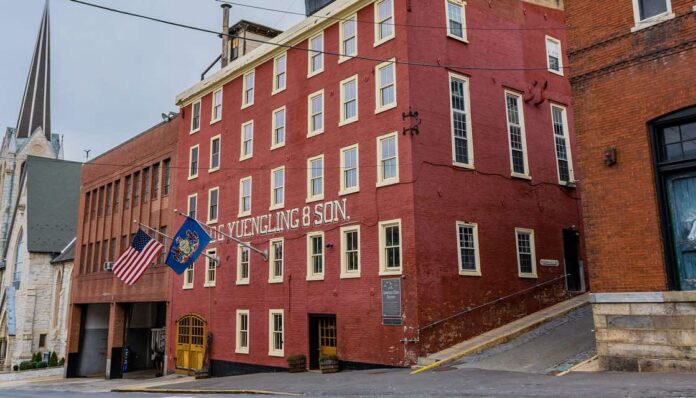
America’s oldest working brewery opened in 1829 in Pottsville, Pennsylvania, when a 23-year-old German immigrant named David G. Yuengling started making ale and porter. Nearly two centuries later, D.G. Yuengling & Son is still pouring, and it is far from the only survivor of its era.
Several of the country’s oldest breweries rank among its biggest, and most of them share a backstory. They were founded by German immigrants, they found clever ways to outlast Prohibition, and they are still producing beer in the towns where they began.
Where American beer began
Beer has been part of American life since 1632, when the Dutch West India Co. opened the first commercial brewery in what is now lower Manhattan. None of those colonial breweries survive today.
What does survive is a group of breweries founded in the 19th and early 20th centuries. Here are seven of the oldest still operating, in the order they opened.
D.G. Yuengling & Son, Pottsville, Pennsylvania, 1829
Yuengling built its name on ale and porter, and it was among the first American breweries to make lager. It holds the title of the oldest operating brewing company in the United States.
Prohibition should have ended it. Instead, the company sold a legal “near beer” containing just 0.5% alcohol and launched a separate business, Yuengling’s Ice Cream, in 1920.
When Prohibition ended in 1933, Yuengling marked the moment by brewing Winner Beer and sending a truckload of it to President Franklin D. Roosevelt. For more than 100 years the brewery mostly served local drinkers, and it only began pushing its beer into other parts of the country in the 1980s.
Pabst Brewing Co., Milwaukee, 1844
Brothers Jacob Best Jr. and Charles Best left Mettenheim, Germany, for Milwaukee in 1842 and started out making vinegar, not beer. Two years later they teamed up with their father and two more brothers to open Best and Co., which turned out roughly 300 barrels a year at first.
After a couple of name changes, the business became the Pabst Brewing Co. in 1889. It was quick to adopt new technology, installing artificial ice machines in 1880 and incandescent lights in 1882, and it was one of the first breweries to welcome the public on tours.
Pabst got through Prohibition by selling a grab bag of products, including near beer, processed cheese, malt syrup and sodas.
Test yourself
How much have you picked up so far?
3 quick questions on what you have read so far. The story continues below.
Christian Moerlein Brewing Co., Cincinnati, 1853
Christian Moerlein arrived in Cincinnati in 1841 and brewed his first beer inside his blacksmith shop. In 1853 he founded his brewery in Over-the-Rhine, a neighborhood filled with fellow German immigrants.
By the late 1800s it was the largest beer producer in both Cincinnati and Ohio and one of the 10 biggest in the nation, making about 500,000 barrels a year. Prohibition hit it harder than most. Non-alcoholic beer did not sell, the giant plant was costly to run, and the company shut down just as the dry years began.
The Christian Moerlein brand came back in 1981 and has been produced ever since.
Also read: McSorley's in New York Has Poured Just Two Kinds of Ale for Over 150 Years
August Schell Brewing Co., New Ulm, Minnesota, 1860
August Schell, another German immigrant, opened his brewery in New Ulm in 1860 after he could not find a German beer he liked. The company's vice president today, Kyle Marti, is a sixth-generation descendant of the founder.
Schell's is the second-oldest family-owned brewery in the United States. It is also both the oldest and the largest brewery in Minnesota.
Anheuser-Busch, St. Louis, 1860
The same year, a German-born soap maker named Eberhard Anheuser bought a struggling St. Louis brewery. He knew little about making beer, so he brought in his son-in-law, the German immigrant brewer Adolphus Busch.
A few firsts followed:
- In the early 1870s it became the first major brewer to pasteurize its beer, which kept it fresh longer and made national shipping possible
- In 1876 Busch introduced Budweiser, a German-style lager designed to suit American tastes, and it became the flagship
- In the 1880s the company pioneered giveaways as a marketing tool and turned the brewery into a tourist stop with public tours
During Prohibition Anheuser-Busch stayed alive by making more than 25 different products, among them soft drinks, ice cream and even truck bodies.
Frankenmuth Brewery, Frankenmuth, Michigan, 1862
Bavarian settlers reached Frankenmuth in 1845, and John Matthias Falliers became the first to brew beer there in 1857. The Cass River Brewery, which later became Frankenmuth Brewery, opened in 1862.
The brewery closed for stretches in the 1980s and 1990s before reopening most recently in 2003, and it is now Michigan's oldest operating brewery. It still follows the 1516 German "purity law," which allowed only barley, hops, water and eventually yeast.
Also read: Old West Saloons Rarely Relied on Swinging Doors Alone, Whatever Westerns Show
Spoetzl Brewery, Shiner, Texas, 1909
The youngest on this list began in 1909, when local businessmen founded the Shiner Brewing Association in a farming town settled by Austrian, German and Czech immigrants. German brewmaster Kosmos Spoetzl took charge in 1914 and started making Bavarian-style beer under his own name.
Spoetzl made near beer and ice to survive Prohibition. When he died in 1950, his daughter Cecile took over and became the only woman in the country running a brewery at the time. The Texas brand stayed local for decades and only began selling outside the state in 1993.
Based on reporting by History.com
By Trivia News Staff | Culture