
In the movies, somebody reads aloud from an Egyptian book of spells and a mummy sits up. Ancient Egyptians did believe written words carried magical power, but they were using that power for the opposite purpose.
The Book of the Dead is a collection of funerary texts and incantations meant to help the dead live again. Its spells were there to restore the senses of the deceased, get them safely through the underworld, and stand them in front of a tribunal of gods to prove they had led a decent life.
It was never one book
There is no single version that all Egyptians owned, and it was not a book in the modern sense at all. Marissa Stevens of the Pourdavoud Institute at the University of California, Los Angeles, describes it as a guide, for the dead and also for the people running the funeral.
The Egyptians called it Going Forth by Day, a reference to leaving the tomb and returning to the light. The name everyone uses now was invented in 1842 by the Egyptologist Richard Lepsius, who numbered 165 chapters in his published edition.
Scholars have since identified more. The count of known spells now runs past 190, and no surviving copy contains all of them. It was never a codified sacred text in the way the Bible is, but one part of a much broader funerary tradition.
You chose your own spells
Most copies were written on papyrus rolls, but the spells also turn up on tomb walls, coffins, mummy wrappings, amulets and inside the funerary mask of Tutankhamun.
The order was not fixed and neither was the selection. What a person got depended on their own preferences, their budget, family tradition and whatever the artisans decided.
That produced some very human results. A husband and wife might order matching Books of the Dead, Stevens says, or deliberately pick spells that complemented each other.
Also read: The Tower of London Held Polar Bears, Spies and a Nine-Day Queen
What the spells were actually for
The first job was the body. Spells protected it from physical decay and made sure the basic needs of the deceased would be met, and during burial priests performed the Opening of the Mouth ceremony, known as wepet-er, to reactivate the eyes, ears, nose and mouth for the life ahead.
The second job was the soul. Stevens explains that the Book of the Dead carries spells to keep the Ba, one part of the soul, free to move between this world and the realm of the dead, and able to rejoin the physical body when needed.
The third job was defense. Spells warded off the threats waiting in the Duat, the Egyptian underworld, and helped the dead become an akh, an effective spirit able to act in the afterlife and reunite with the people they had lost.
Turning into a crocodile, on purpose
Some of the strangest spells let the deceased change shape, and each transformation bought a specific advantage.
- Becoming a crocodile allowed safe passage through the waters of the underworld, protected from aquatic monsters
- Taking the form of a serpent offered regeneration, the way snakes renew themselves by shedding skin
- Becoming the sun god Ra tied the deceased to the sun’s daily cycle of rebirth
- Taking the form of Ptah brought creative power and stability
The strongest option was Osiris himself. As Stevens puts it, the most powerful transformation is into Osiris, which hands the deceased all the regenerative powers of the lord of the underworld.
The weighing of the heart
Chapter 125 is among the best known, because it describes the judgment and the ritual that goes with it.
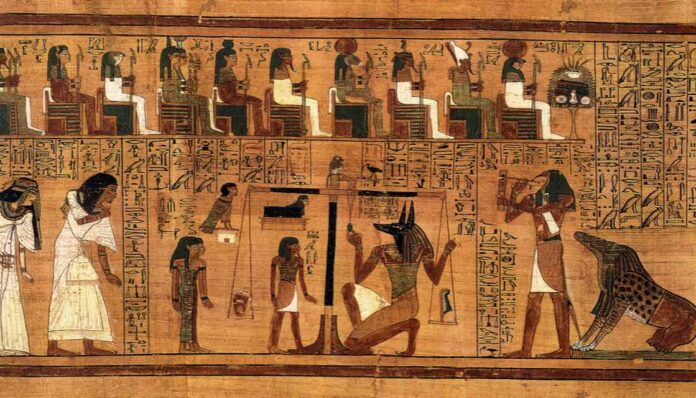
Before the test, the deceased had to satisfy Osiris and a tribunal of 42 gods that they had lived virtuously. They did it by reciting the Negative Confession, a series of declarations that ran along the lines of I have not killed, I have not stolen, I have not told lies, I have not been angry without reason.
Then came the scale. The heart went on one side and the feather of Ma’at, the symbol of truth and order, on the other, while Thoth, the god of wisdom, recorded the outcome. To pass, the heart had to balance against the feather, which is as neat a summary of a life well lived as anyone has managed since.
Based on reporting by HISTORY
By Theresa Vance | History